For Parents
Teach Your Child the 4 Quls in 40 Days (Without Tears)
Picture a child at bedtime, whispering a surah to you from memory. No flashcards, no frowning, no “try again”. Just a small voice, a proud face and a marker that has just coloured in the last circle.
That picture is why we made My 4 Quls. It is a 40-day workbook that helps children learn Surah Al-Ikhlas, Al-Falaq, An-Nas and Al-Kafirun, one small verse at a time. This guide shows you how it works, with real pages from the book, and why these four short surahs are worth the effort.
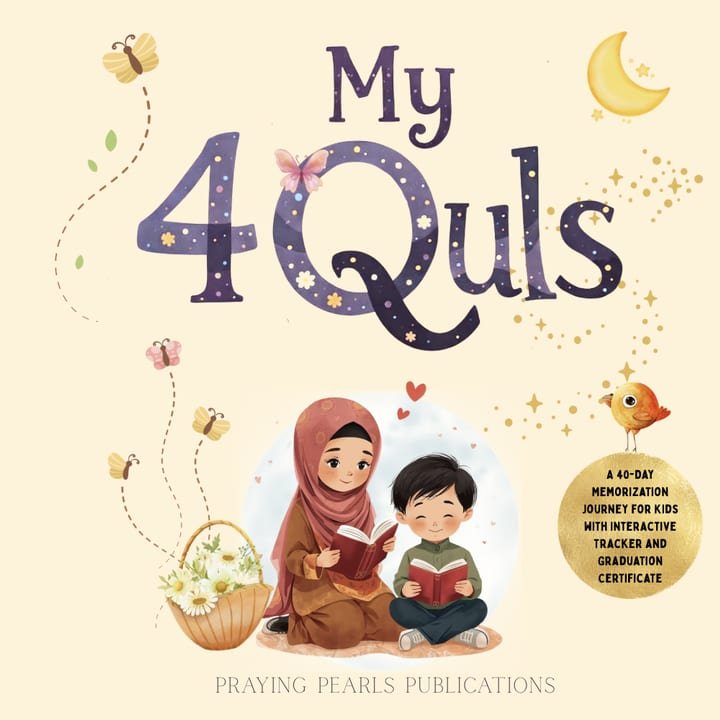 My 4 QulsA 40-Day Memorization Journey for Kids · Ages 5–10
What are the 4 Quls?
The 4 Quls are four short surahs of the Quran, and each one begins with the word “Qul”, which means “Say.” That one word is an invitation. Allah is not only telling the Prophet (P.B.U.H) what to say; He is inviting every reader to say it too.
- Surah Al-Ikhlas (112): Allah is One.
- Surah Al-Falaq (113): asking Allah for protection from what we cannot see.
- Surah An-Nas (114): asking Allah to keep our hearts calm and clean.
- Surah Al-Kafirun (109): being proud and steady in what we believe, while respecting everyone.
Between them they teach a child four things: who Allah is, where to run when scared, how to guard the heart, and how to stand firm. That is a lot of wisdom in just 21 verses.
Why these four surahs matter
Ask a parent which surahs they most want their child to know, and these usually come first. Here is why.
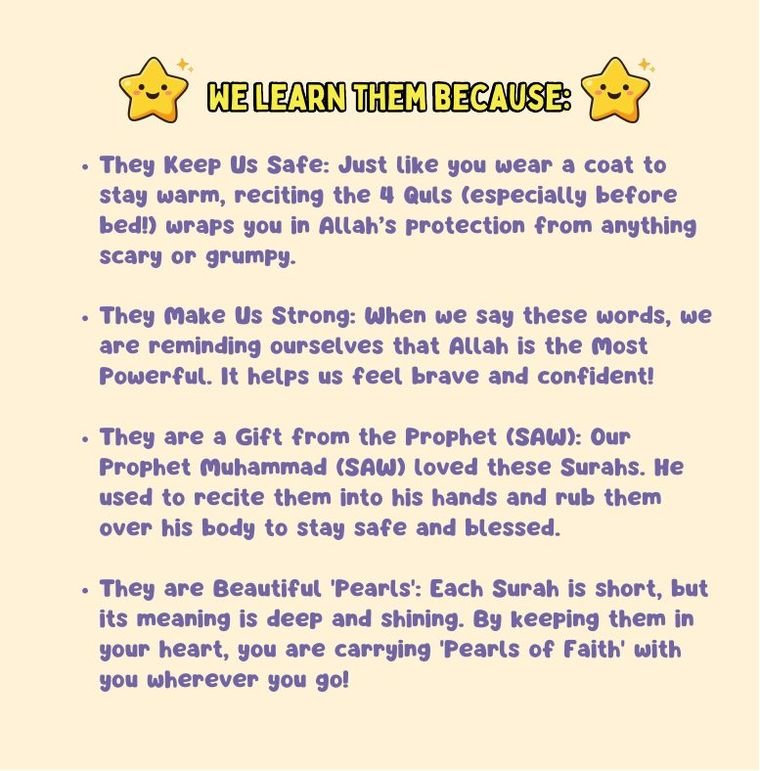
1. They are a gentle shield
Many families recite them at bedtime and in the morning, asking Allah to keep their children safe. Reports from the Prophet (P.B.U.H) describe him reciting the last three surahs of the Quran, blowing gently into his hands and wiping them over his body before sleep, and the same habit is recommended in Shia collections of hadith. We describe it as it is widely reported; for the exact wording and source, ask your own scholar.
My 4 Quls puts it in a way a five-year-old understands: “Just like you wear a coat to stay warm, reciting the 4 Quls wraps you in Allah’s protection.”
2. They teach tawhid before a child can ask “why?”
Surah Al-Ikhlas is four lines long and says everything: Allah is One, Allah is the Eternal Refuge, He has no children or parents, and nothing is like Him. A narration, reported in Shia and Sunni hadith collections, says reciting it carries the reward of a third of the Quran. For a child it becomes the first answer to “Who is Allah?”
“Say, ‘He is Allah, [who is] One. Allah, the Eternal Refuge. He neither begets nor is born, nor is there to Him any equivalent.’”
Quran, Al-Ikhlas 112:1–4Four lines a child can say with their whole heart.
3. They give a child words for big feelings
Children feel fear, jealousy and “whispers” that make them grumpy long before they have language for them. Al-Falaq and An-Nas give them that language, and tell them what to do: run to Allah. That is a coping skill, not only a surah.
4. They are small enough to succeed at
This one matters more than it sounds. A child who finishes something real, with the word of Allah, learns that they can. That confidence travels into longer surahs, and into everything else.
The Quran itself says it was made easy for this purpose:
“And We have certainly made the Quran easy for remembrance, so is there any who will remember?”
Quran, Al-Qamar 54:17
Why memorising often goes wrong
Most of us learned by repeating a surah until it stuck, usually under pressure, and that is why many children come to associate the Quran with being tested. Three things tend to go wrong:
- Too much at once. A whole surah on day one is overwhelming.
- No visible progress. A child cannot see how far they have come.
- No celebration. The moment of success passes unnoticed.
My 4 Quls fixes all three: one verse at a time, a tracker you can see, and a party at every milestone.
The method: 2 days per verse and four small steps
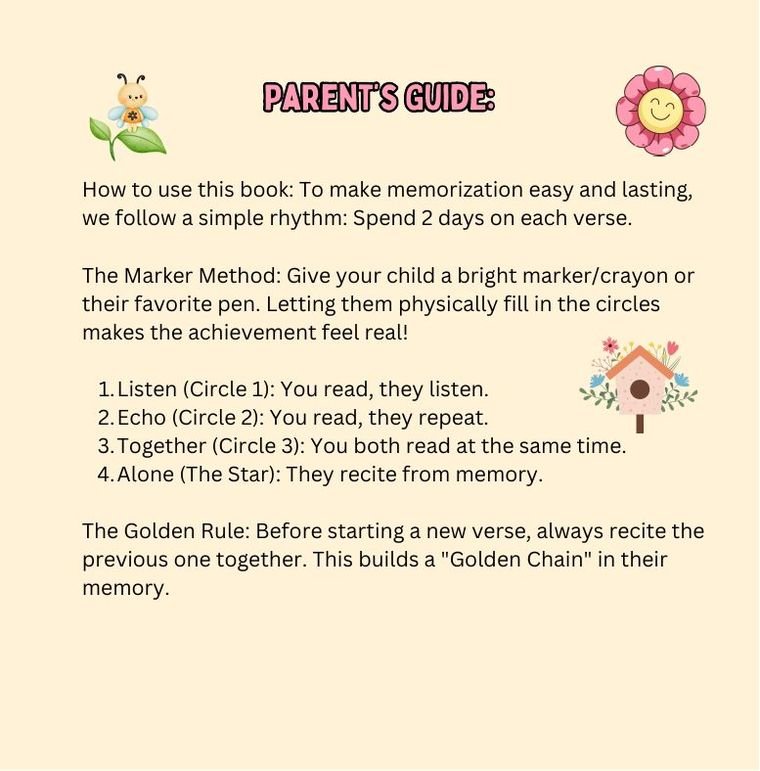
The Parent’s Guide in the book is only a paragraph long, which is the point. The rhythm is: spend two days on each verse. Each verse page has three circles and a star:
- Listen (circle 1). You read, they listen.
- Echo (circle 2). You read, they repeat.
- Together (circle 3). You both read at the same time.
- Alone (the star). They recite from memory.
Then the Marker Method: give your child a bright marker or crayon and let them colour each circle themselves. Touching the progress, not just seeing it, makes the achievement feel real.
And one rule ties it together, the Golden Rule: before starting a new verse, always recite the previous one together. This builds what the book calls a “Golden Chain” in their memory, where each verse is held by the one before it.
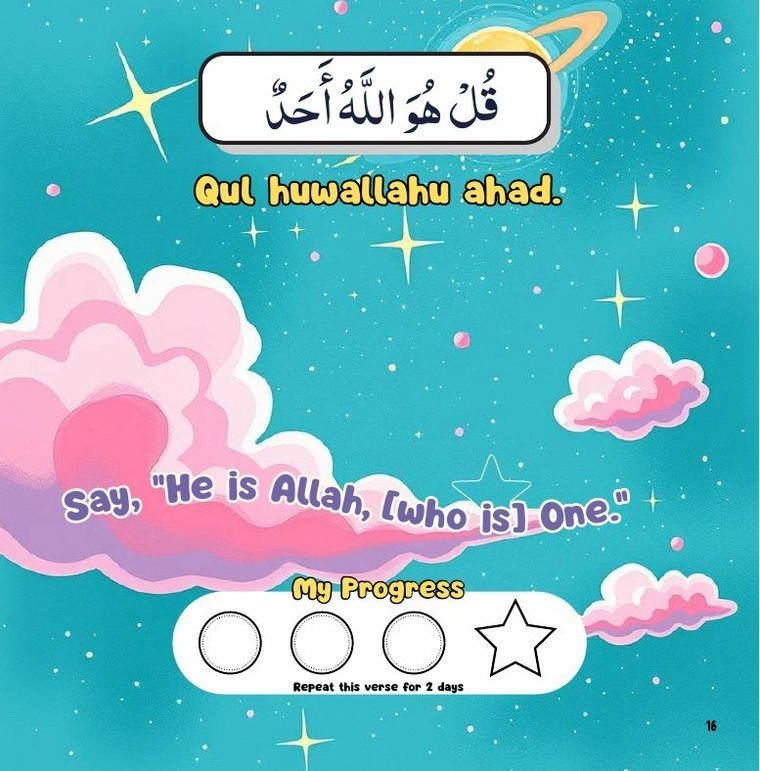
What a verse page looks like
Every verse gets its own page so a child never has to take in more than one idea. Arabic at the top, a transliteration you can read aloud, the English meaning in simple words, and the progress circles at the bottom. The pictures change with the surah: sunrise for Al-Falaq, floating islands for An-Nas, the sea for Al-Kafirun.
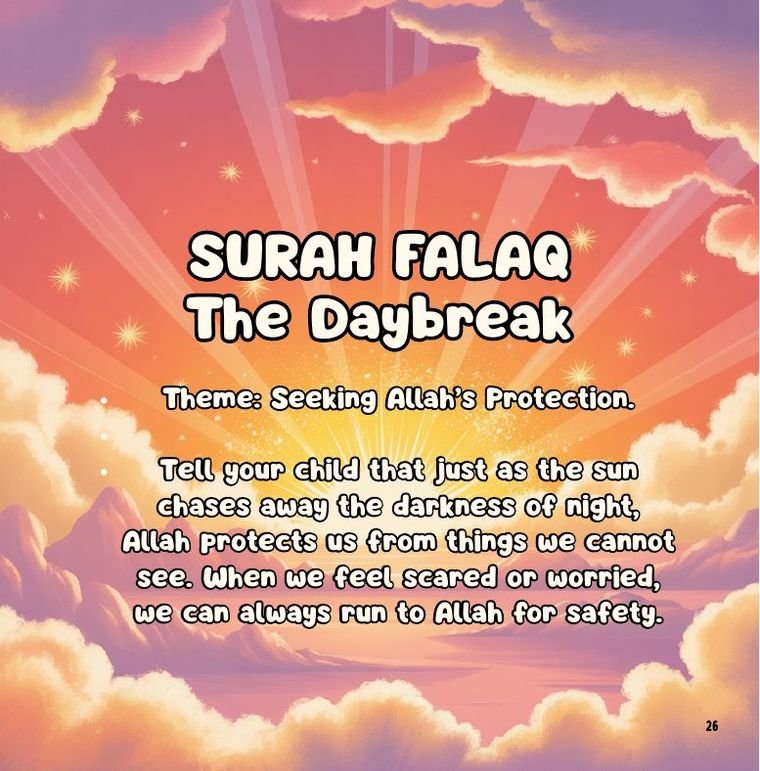
Each surah opens with a one-line note to the parent, a theme to tell your child before you start. That is where the real teaching happens.
The four surahs, as the book teaches them
Al-Ikhlas: Allah is One
The book’s note to parents: “Tell your child that Allah has no partners and no family like ours; He is the Creator of everything!” It is eight days of the plan, and the first small victory.
Al-Falaq: Seeking Allah’s protection
Dawn is the image. The book says: “Just as the sun chases away the darkness of night, Allah protects us from things we cannot see. When we feel scared or worried, we can always run to Allah for safety.” It is ten days, and it is the one children often love most because it answers the fear at bedtime.
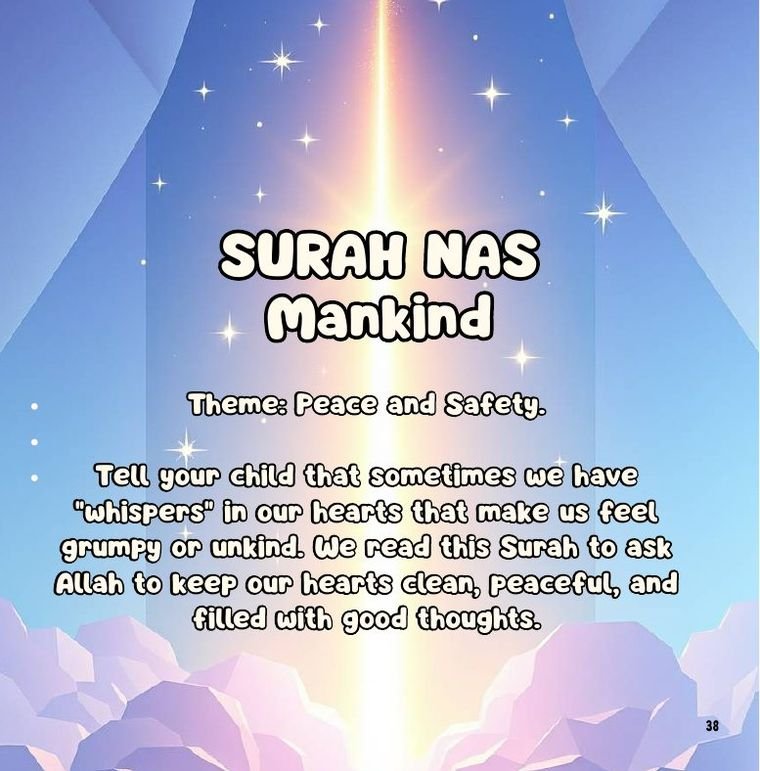
An-Nas: Peace and safety
Here the book names something every parent recognises: “Sometimes we have ‘whispers’ in our hearts that make us feel grumpy or unkind. We read this Surah to ask Allah to keep our hearts clean, peaceful and filled with good thoughts.” It is twelve days, with six verses, and it is a lovely moment to talk about feelings.
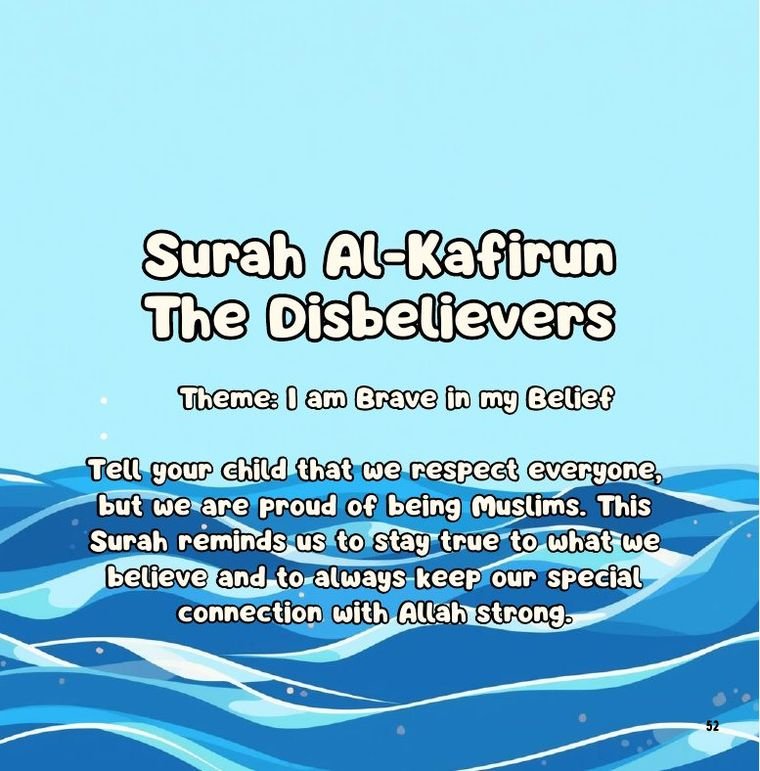
Al-Kafirun: I am brave in my belief
This is the surah most adults find hardest to explain to a child, and the book handles it with care: “We respect everyone, but we are proud of being Muslims. This Surah reminds us to stay true to what we believe and to always keep our special connection with Allah strong.” It is not a lesson in difference; it is a lesson in confidence and kindness together.
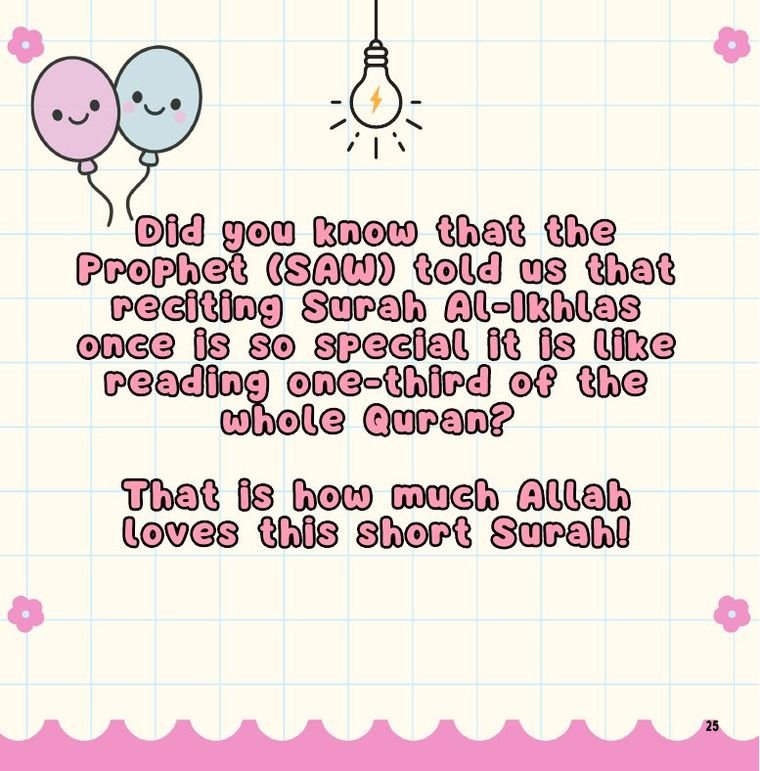
Two more details that parents like: after Al-Falaq and An-Nas the book includes a “Did You Know?” page explaining that these two are called the Mu’awwidhatayn, “the two seekers of protection”, a matching set of armour for the heart. After Al-Ikhlas, another page tells your child that the Prophet (P.B.U.H) said reciting it once is like reciting one-third of the Quran.
The 40-day roadmap
Here is the whole journey at a glance. It fits on a page, which means you can stick it on the fridge.
- Days 1 to 8: Surah Al-Ikhlas, 4 verses at 2 days each.
- Days 9 to 18: Surah Al-Falaq, 5 verses at 2 days each.
- Days 19 to 30: Surah An-Nas, 6 verses at 2 days each.
- Days 31 to 40: Surah Al-Kafirun, five different verses at two days each. The surah has six verses, but verses 3 and 5 use the same words, so the book counts five.
- Day 40: the Grand Recital of all four to the family, then the certificate.
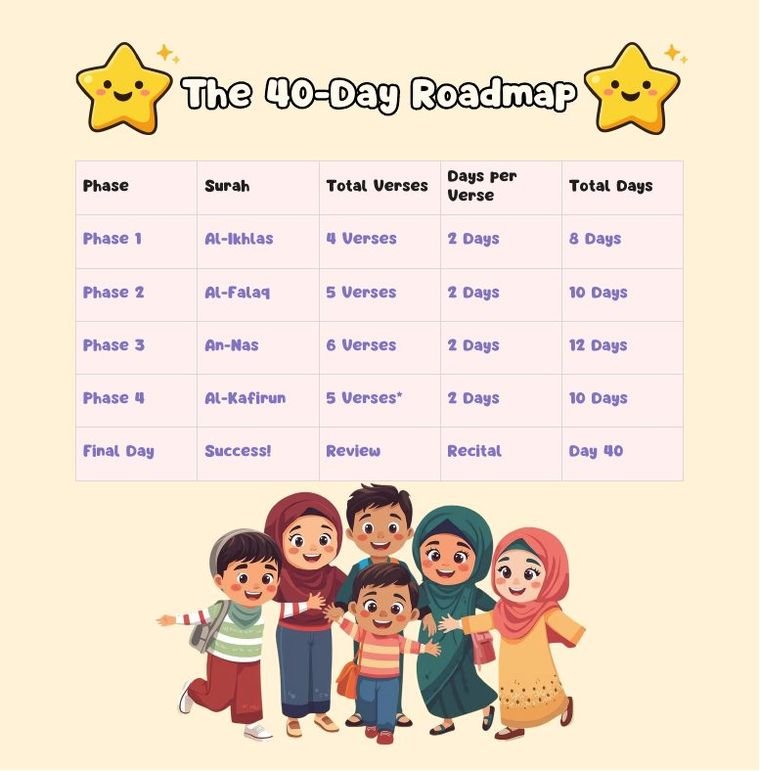
The structure is the secret: every two days a child finishes something, and every finish is marked.
Celebration is built in
This is the part we are proudest of. After every surah, children get:
- A “MashaAllah!” page that tells them what they have just done in a sentence they can read aloud.
- An “I Can Say It” checklist: recite to Mum or Dad, to a grandparent or friend, and with eyes closed.
- A “Shukar, Alhamdulillah” page, so gratitude is part of every success.
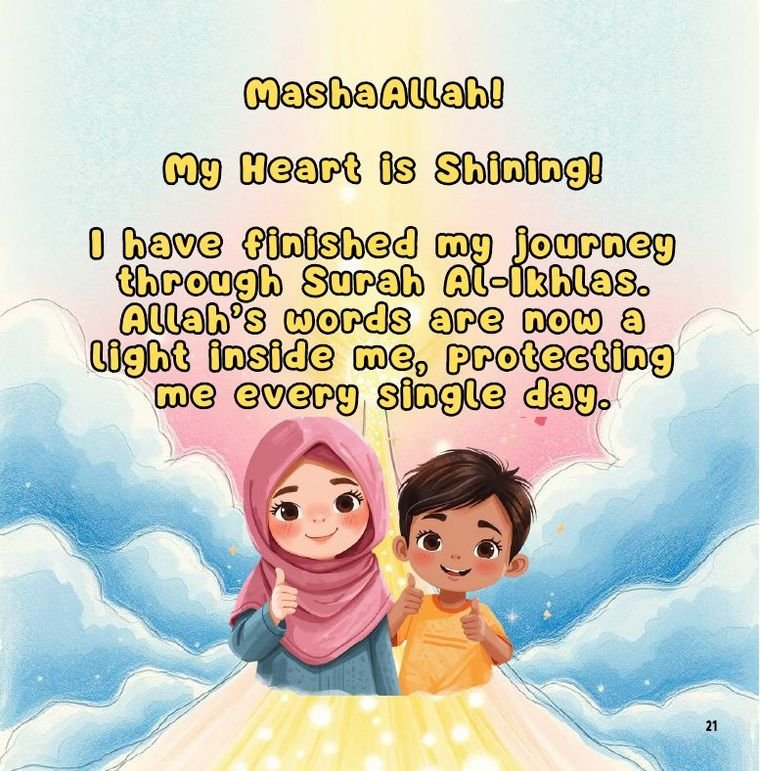
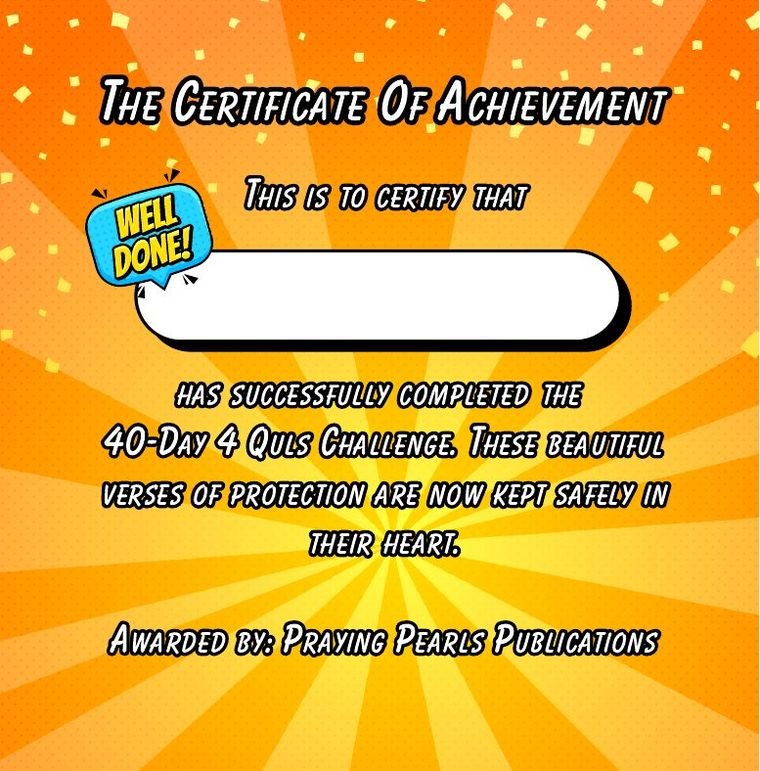
At the end there is a Grand Graduation Recital, a certificate of achievement, a page for notes from the family and a graduation photo spot. Many children keep this page for years.
A first-week plan you can start tonight
Whether or not you have the book yet, you can start the Surah Al-Ikhlas week now. Choose a time you already have, such as after Maghrib or before bed.
- Days 1 and 2. Verse 1: “Qul huwallahu ahad.” Day 1 you say it and they listen, then repeat. Day 2 you say it together, then they try alone. Tell them: “It means Allah is One.”
- Days 3 and 4. Say verse 1 together first (the Golden Rule). Then verse 2: “Allahus-samad.” Ask: “What do you think the Eternal Refuge means?” (The One we can always run to.)
- Days 5 and 6. Verses 1 and 2 together, then verse 3: “Lam yalid wa lam yulad.”
- Days 7 and 8. Everything so far, then verse 4: “Wa lam yakun lahu kufuwan ahad.”
That is all. At the end of day eight, say the whole surah together, fill in the last star, and celebrate.
Practical tips from the book’s approach
- Same time, same place. Five minutes at bedtime beats thirty minutes on a weekend.
- Never test in public. Let your child choose who hears the recital.
- Missed a day? Carry on. There is no failure column in this book; just repeat the verse.
- Pair it with a reciter. Let your child hear a good qari for pronunciation, and give the surahs a melody.
- Talk about meaning. A child who knows what “Eternal Refuge” means will remember it longer.
- Praise effort, not perfection. “You came back today” is a better sentence than “you got it right.”
For classrooms and Sunday schools
The same rhythm works for a group. Teachers use the circles as a class chart, award the certificates together and invite parents for the Grand Recital. If you teach a class and want a bulk order, ask for a quote on our schools page.
More to read with your child
The 4 Quls are part of our Pearls of Faith series and sit well beside these books:
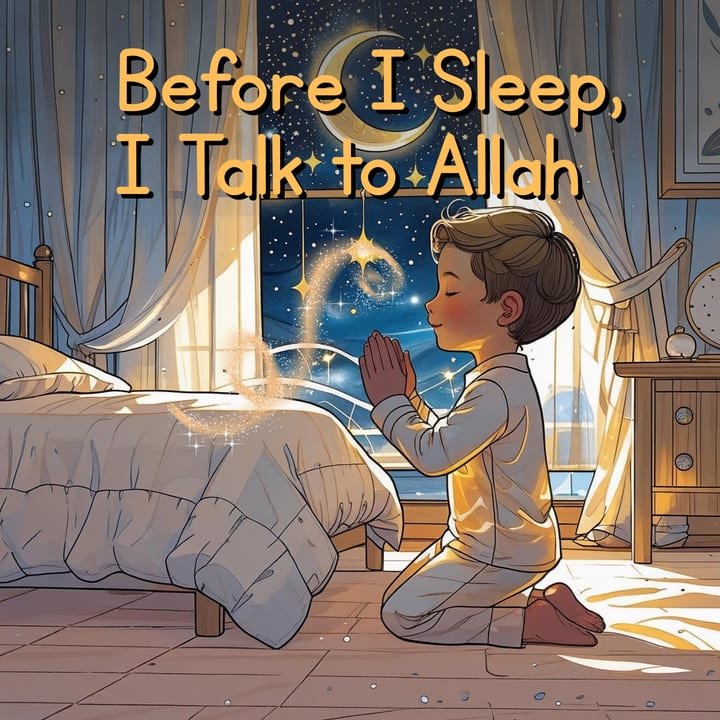 Before I Sleep, I Talk to AllahA Bedtime Book of Gratitude and Prayers
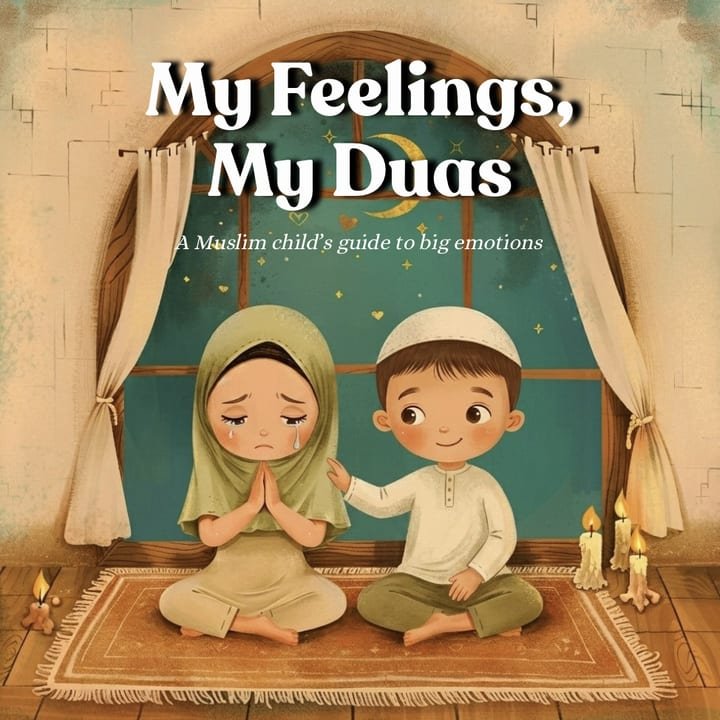 My Feelings, My DuasA Muslim Child’s Guide to Big Emotions · Ages 5–9
And for the surahs your child already knows, our guide to bedtime duas for kids shows how to fit them into a calm evening routine.
Frequently asked questions
What are the 4 Quls?
They are four short surahs of the Quran that each begin with the word “Qul” (“Say”): Surah Al-Ikhlas (112), Surah Al-Falaq (113), Surah An-Nas (114) and Surah Al-Kafirun (109). Many families recite them in the morning, at night and whenever they want to ask Allah for help.
At what age can a child start learning the 4 Quls?
Many children can begin around age four or five by listening and echoing. My 4 Quls is written for ages 5 to 10, and younger children can take part by listening and repeating while a parent reads. Go at your child’s pace; nothing is lost by taking longer.
How long does it take to memorise the 4 Quls?
In the My 4 Quls plan it takes 40 days: 8 days for Al-Ikhlas, 10 for Al-Falaq, 12 for An-Nas and 10 for Al-Kafirun, with a final day for a recital to the family. Every new verse gets two days, then the previous verse is revised before starting the next. Al-Kafirun has six verses but one wording appears twice, so the book counts five.
Why is Surah Al-Ikhlas said to equal a third of the Quran?
It is reported from the Prophet (P.B.U.H), in both Sunni and Shia hadith collections, that reciting Surah Al-Ikhlas carries the reward of reciting a third of the Quran. It is because the surah sums up tawhid, the oneness of Allah, which is a central theme of the whole Quran. Scholars explain the reward in different ways, so ask your own scholar if you want the detail.
What does “Mu’awwidhatayn” mean?
It means “the two seekers of protection”, a name given to Surah Al-Falaq and Surah An-Nas, because both begin with “I seek refuge in the Lord…”. My 4 Quls explains this to children as a matching set of armour for the heart.
Will this book teach correct pronunciation?
It gives Arabic, transliteration and English for every verse, which is a good start. For accurate tajweed, also let your child listen to a good reciter, or learn with a teacher. A book supports a teacher; it does not replace one.
Can a classroom or Sunday school use it?
Yes. The two-day rhythm, the progress circles and the certificate suit a group, and bulk orders are available. See our schools page to ask for a quote.