For Parents
Allah’s Signs in the Honeybee’s Eye and Your Child’s Eye
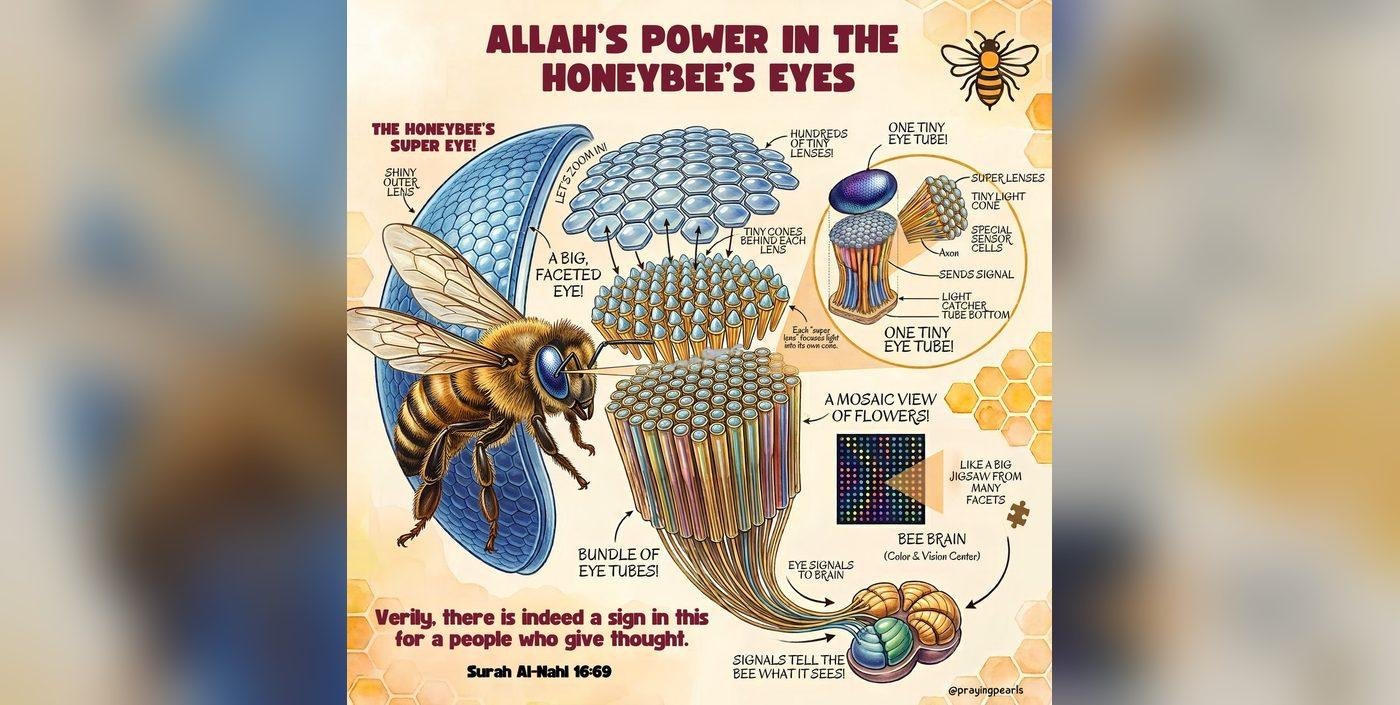
Hold a honeybee’s eye under a microscope and you will see something astonishing: a honeycomb of tiny lenses, each one catching its own small piece of the world. Hold your child’s own eye up to a mirror and you will see another marvel, a living camera with an adjustable window, a focusing lens and a screen made of millions of light-catching cells.
Neither of these was built by accident, and children feel that instinctively. This guide shows you how to turn that feeling into a lasting love of Allah, with facts you can trust and activities you can do tonight.
What the Quran invites us to do
The Quran does not just tell us to believe. It tells us to look. It points to the sky, the earth, the camel, the rain, the human body, and the bee.
“And your Lord inspired the bee… Then eat from all the fruits and follow the ways of your Lord laid down [for you]. From its belly comes a drink, varying in colours, in which there is healing for people. Indeed in that is a sign for a people who give thought.”
Quran, An-Nahl 16:68 to 69
The last phrase is the invitation: a people who give thought. We are not asked to switch our minds off. We are asked to switch them on, and let what we find turn our hearts to the One who made it.
The honeybee’s super eye
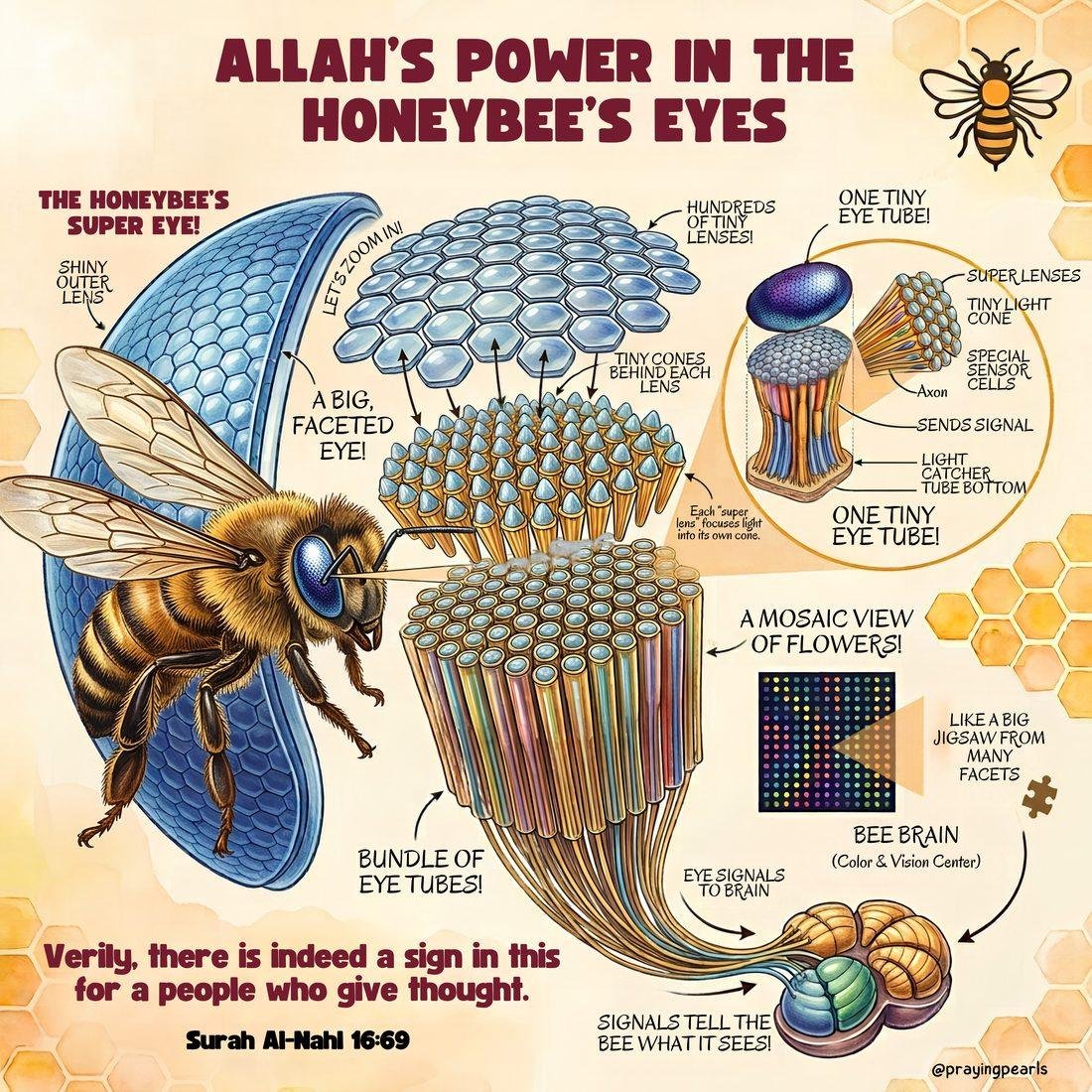
Look closely at a bee’s head and you will see two large eyes. Each is not one lens but thousands, and here is how the parts work together, in language a child can follow:
- Hundreds and hundreds of tiny lenses. Each six-sided lens, called a facet, looks at its own small patch of the world. Together they make a mosaic, like a picture made of dots.
- A tiny cone behind each lens. It funnels the light down into the eye tube beneath.
- One tiny eye tube for each lens. At the bottom are special sensor cells that turn light into a signal.
- A bundle of tubes. Thousands of these units sit side by side, pointing in slightly different directions, so the bee gets a very wide view.
- A signal to the bee’s brain. The brain stitches the many small pictures into one, like a jigsaw from many pieces.
Facts you can trust
- A worker honeybee’s eye contains roughly five to seven thousand tiny units. Scientists call each one an ommatidium.
- Bees see ultraviolet, blue and green light. Flowers often have ultraviolet “landing strips” that guide them in, invisible to us.
- Bees are excellent at noticing movement, which helps them fly fast and land accurately on flowers.
- Honeybees use the sun’s position and a famous “waggle dance” to tell their hive-mates where food is. Different honeybee populations are known to have slightly different dance “dialects.”
Ask your child: who taught the bee all of this? The Quran’s answer is gentle and complete: “Your Lord inspired the bee.” The same Allah who gave a tiny insect this ability looks after your child with even greater care.
Your child’s own eye
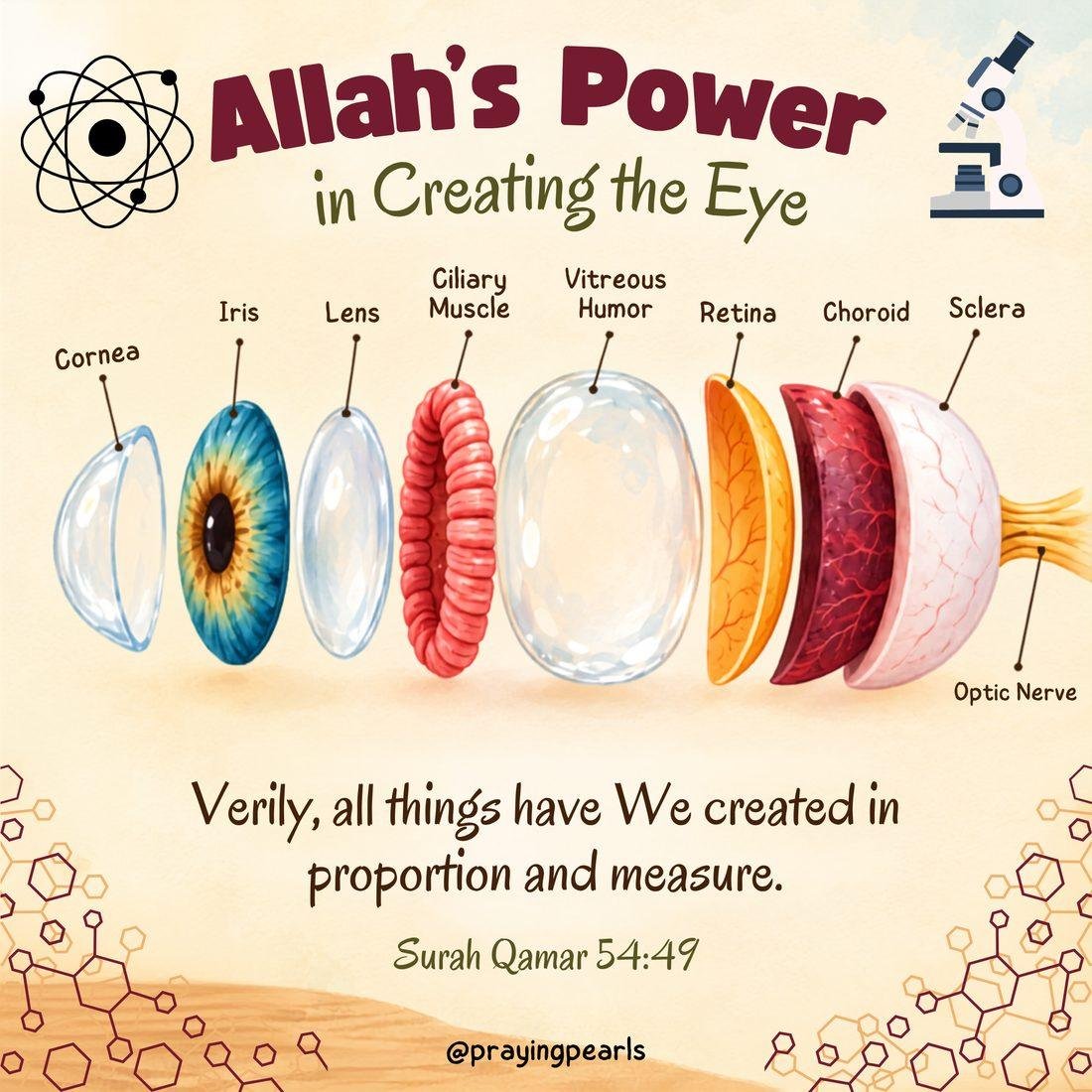
The human eye is just as astonishing, and children can learn its parts like a team of helpers:
- Cornea: the clear front window. It does most of the bending of light.
- Iris: the coloured ring. It makes the pupil bigger in dim light and smaller in bright light.
- Lens: the fine-tuner. It changes shape so you can see near things and far things clearly.
- Ciliary muscle: the tiny muscle that squeezes the lens into the right shape.
- Vitreous humour: the clear jelly that fills the eyeball and keeps it round.
- Retina: the screen at the back. It holds about 120 million rod cells (for dim light) and 6 million cone cells (for colour).
- Choroid: the layer of blood vessels that feeds the retina.
- Sclera: the tough white outer wall.
- Optic nerve: the cable that carries the picture to the brain, which turns it the right way up.
Then ask the question the Quran asks: “Have We not made for him two eyes?” (Quran 90:8). Your child’s eyes are not just tools. They are gifts, and gifts are a reason to love the Giver.
Five hands-on activities
- Hexagon hunt. Look for six-sided shapes around the house and garden: honeycomb pictures, tiles, snowflake photos. Draw a honeycomb together and colour in each cell a different colour, like a bee’s mosaic view.
- Straw-bundle eye. Tape a handful of drinking straws together, and look at a picture through them. Each straw lets you see one small circle. Imagine thousands working together.
- Magnifier safari. Use a magnifying glass on flowers, leaves and, if you find one, a bee (from a respectful distance, never touching). Count the details you would never see otherwise.
- Pupil watch. Look in a mirror in a dim room, then switch the light on. Watch the pupil shrink. This is the iris at work. Do not use a torch or bright light directly in anyone’s eyes.
- Find your blind spot. Draw a small cross on the left of a sheet of paper and a dot about eight centimetres to its right. Close your left eye, look at the cross with your right eye, and move the page slowly closer. At one point the dot will disappear. This is the place where the optic nerve leaves the eye. Allah made it so cleverly that our brain fills the gap, and we never notice.
Why this works for faith
- It builds love through awe. Children who are amazed by creation are already halfway to loving the Creator.
- It protects against the idea that science and faith are enemies. Your child learns early that careful looking leads to more faith, not less.
- It makes dhikr natural. Subhanallah (glory be to Allah) is the right response to wonder. Say it together.
- It gives them something to share. Children love to tell others what they have discovered.
Keep going after this one activity. Choose one creature or body part each week, learn three true facts, and end with the verse that fits. In a year you will have given your child a living library of signs.
 99 Names of AllahAsma ul Husna for Children: Learn the Beautiful Names of Allah · learn the names behind the signs · Ages 5–12
For the bigger picture, read our guide to helping your child fall in love with Allah.
Common questions
What does the Quran say about bees?
Surah An-Nahl (“The Bee”) says that your Lord inspired the bee to make homes, to feed on fruits and to follow the ways made easy for it, and that from its belly comes a drink of varying colours in which is healing for people. The verse ends: “Indeed in that is a sign for a people who give thought” (Quran 16:68 to 69).
Is it true that bees see a different range of colours from us?
Yes. Honeybees see ultraviolet, blue and green light, but they do not see red the way we do. Many flowers have ultraviolet patterns that guide bees to the nectar, and these are invisible to human eyes.
How many lenses are in a honeybee’s eye?
A honeybee’s compound eye is made of several thousand tiny units called ommatidia, each with its own lens. The exact number depends on the type of bee, with workers having around five to seven thousand per eye.
How can I explain the human eye to a young child?
Call it a tiny camera that Allah made. The clear front window is the cornea, the coloured ring is the iris that opens and closes like a curtain, the lens focuses, and the back of the eye (the retina) catches the picture and sends it to the brain.
Does science take away from faith?
In the Quranic view it does the opposite. The more carefully we look at creation, the more signs we find. The Quran repeatedly asks us to observe and reflect, including “Have We not made for him two eyes?” (Quran 90:8).